Installing solar panels costs about $30,505 for an average system in 2026
That is a 12 kW system at about $2.58 per watt, the EnergySage marketplace average, before any incentives. Most 12 kW quotes there run $25,962 to $34,105. The federal 30 percent tax credit no longer applies to homeowner owned systems placed in service after December 31, 2025, so do not subtract it.
Cost by system size
| 4 kW | About $11,440 at $2.86 per watt. |
|---|---|
| 6 kW | About $15,960 at $2.66 per watt. |
| 8 kW | About $20,880 at $2.61 per watt. |
| 10 kW | About $25,500 at $2.55 per watt. |
| 12 kW, the average system | About $30,505 on EnergySage. Range $25,962 to $34,105. |
| 15 kW | About $36,600 at $2.44 per watt. |
| Panels themselves | Only about 12 percent of the total cost in EnergySage's data. |
What pushes a quote up
| System size | Bigger systems cost less per watt, but more in total. |
|---|---|
| Where you buy | Berkeley Lab's median cash price was $3.50 per watt in 2024, almost a dollar above competitive marketplace quotes. |
| Your state | From about $2.35 per watt in Texas to $3.18 in New Hampshire. |
| Financing | Loan deals often roll dealer fees into the contract price. |
| Roof and electrical | An old roof or a full panel can add thousands before the panels go on. |
Solar panel installation cost by region
| Lower cost states | $20,800 to $27,300. Alabama, Arkansas, Indiana, Iowa, Kansas, Kentucky, Mississippi, Missouri, Oklahoma, Tennessee, West Virginia and most rural areas. |
|---|---|
| Average cost states | $25,962 to $34,105. Arizona, Florida, Georgia, Michigan, North Carolina, Ohio, Pennsylvania, Texas, Virginia and most mid size cities. |
| Higher cost states | $33,800 to $44,300. California, Connecticut, Hawaii, Massachusetts, New Jersey, New York, Washington, plus big metros such as Chicago, Denver and Washington DC. |
These rows are our estimate. We took the typical national range and adjusted it for local labor costs, which run about 20 percent lower in the cheapest states and about 30 percent higher in the dearest ones. Hot states tend to have lower prices per watt but need bigger systems, so totals can end up close to cold states.
The tax credit is gone, and many quotes have not caught up
For years, solar quotes showed a price and then a price after the 30 percent federal credit. NRG Clean Power spells it out: the residential clean energy credit, Section 25D, no longer applies to homeowner owned systems placed in service after December 31, 2025. On a $30,505 system that is a $9,150 difference. Some 2026 articles and sales decks still show the old math. If a quote subtracts 30 percent, ask the installer to show you in writing which credit they mean.
Leases and power purchase agreements are different, because the solar company owns the system. Those deals may still use business credits. That is a reason to read them closely, not a reason to sign.
Two prices for the same system
EnergySage's $2.58 per watt comes from installers bidding against each other on its marketplace. Berkeley Lab's national median for cash purchases in 2024 was $3.50 per watt. That gap is roughly what a homeowner pays when a single company knocks on the door. On 12 kW it is about $11,000. Get at least three bids.
Why this costs more in 2026
Solar equipment is imported, and electricity prices are rising, which is why more people are asking. NEADA projects electric heating bills up 9 percent this winter.
Fuel is the common thread. AAA's national average for diesel passed $6 a gallon for the first time on September 11, 2026, up from about $3.70 a year earlier (CBS 8 reporting AAA). Every truck roll and every delivery carries that. Materials moved too. Associated Builders and Contractors reported construction input prices up 4.8 percent in a year as of March 2026, the largest annual gain since January 2023, and the Associated General Contractors said diesel jumped 37.8 percent in one month, the largest one month rise since 1990 (Roofing Contractor, April 2026). Some suppliers added freight surcharges this year. Ask how long your quote is good for.
How to judge the quote in your hand
- Divide the price by the watts. Compare that number to $2.58 and to your state's average.
- Check the incentive math. No federal 30 percent credit for homeowner owned systems in 2026.
- Look for dealer fees in a loan. Ask for the cash price next to the loan price.
- Ask who fixes the roof. Panels come off to replace a roof. Get the price for that.
- Check the production estimate. It should use your roof's direction and shade, not a default.
Ways to pay less
- Get three competing quotes. The marketplace price is about a dollar a watt below the national median.
- Pay cash or bring your own loan. It avoids built in dealer fees.
- Replace an old roof first. So you do not pay to remove and reinstall panels later.
- Check state and utility programs. Some still offer rebates or credits.
What will this cost me?
Pick the job, your state's cost level and the last detail. The estimate updates as you change them.
An estimate built from published 2026 cost guides. It is not a quote. Get a written quote before work starts.
The one business per trade, per town that AI recommends.
When your customers ask an AI which company to call, we get you named, not your competitor. We work and monitor every major engine, ChatGPT, Google's AI Overviews, Gemini, Perplexity, Copilot, Claude, and Grok, so you show up wherever they ask. Fully done-for-you: setup, ongoing optimization, competitor tracking, a live dashboard, and monthly reporting. Backed by our 90-day money-back guarantee.
Book a free 15 minute callNo pitch deck. We run your audit live on the call.Common questions
How much does it cost to install solar panels?
About $2.58 per watt in 2026 on the EnergySage marketplace, or $30,505 for an average 12 kW system before incentives.
Is there still a 30 percent solar tax credit?
Not for homeowner owned systems placed in service after December 31, 2025, according to NRG Clean Power's 2026 guide.
How much does a 10 kW solar system cost?
About $25,500 at $2.55 per watt, before incentives.
Why do solar quotes vary so much?
Competitive marketplace quotes average $2.58 per watt. Berkeley Lab's median cash price was $3.50.
What part of solar cost is the panels?
About 12 percent. Labor, inverters, racking, permits and overhead are the rest.
Other jobs and rates
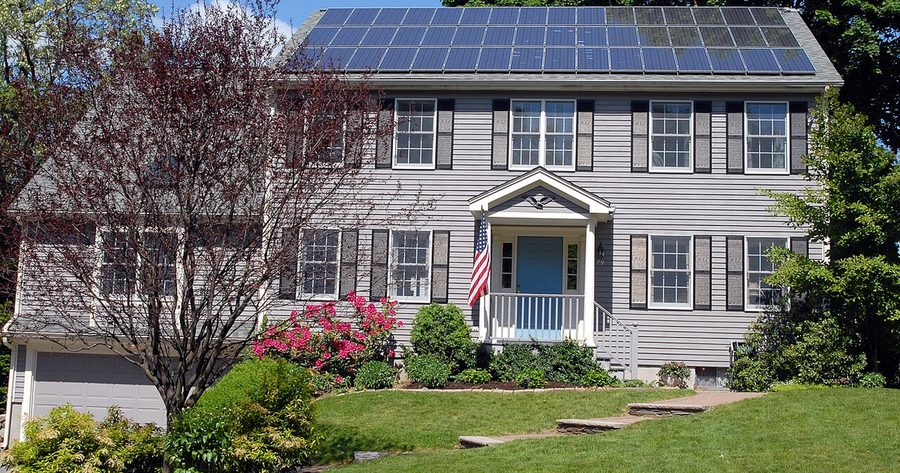
Photo: Gray Watson, Wikimedia Commons, CC BY-SA 3.0, cropped.